
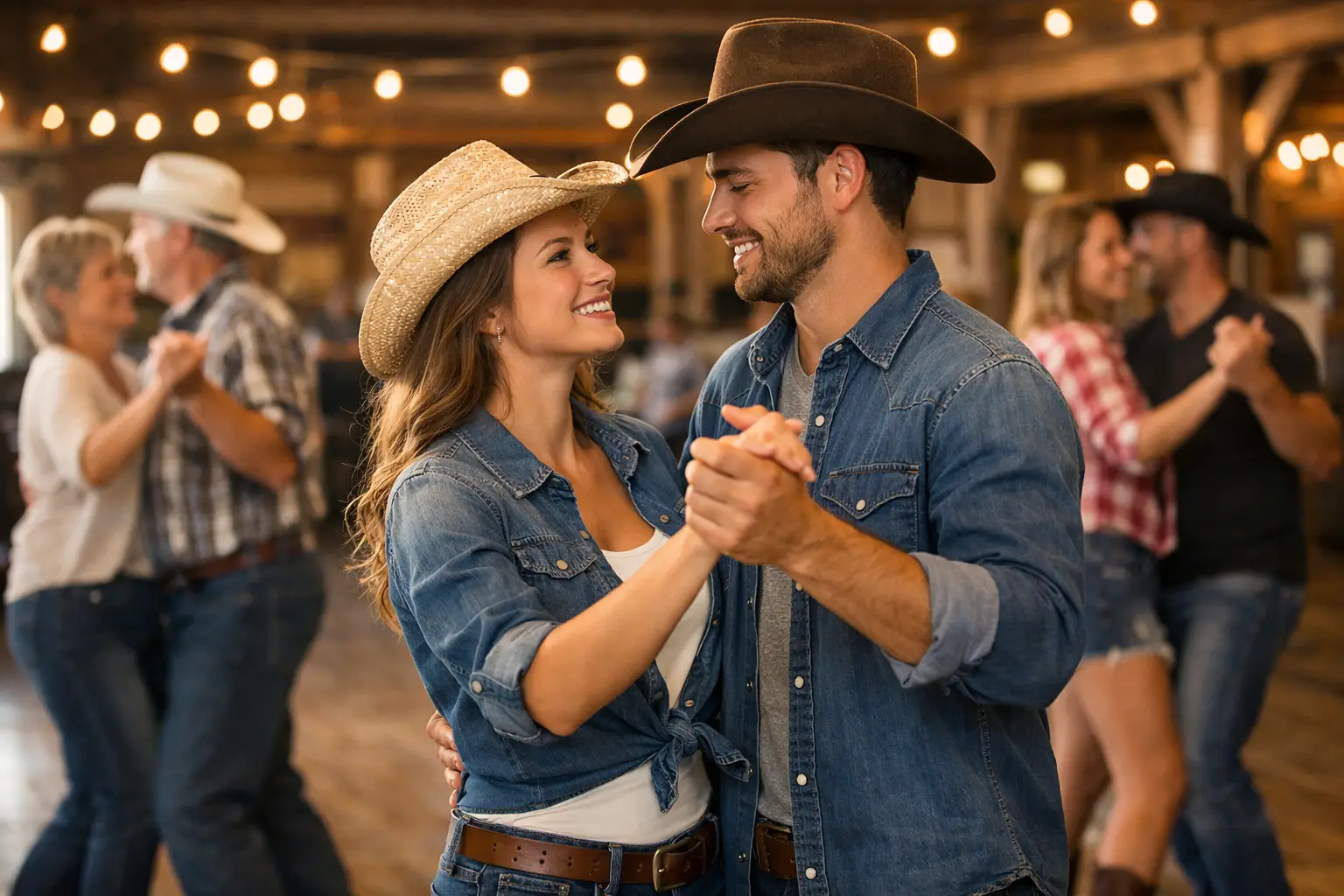
Walking into your first country lesson should feel more like arriving at a great night out than auditioning for a dance competition. This country dancing class guide is here to take the mystery out of your first few steps, whether you picture yourself two-stepping at a local dance hall, trying a country swing turn, or finally feeling at home when a favorite song comes on.
Country dancing is social, practical, and wonderfully forgiving. You do not need fancy boots, a partner, or a background in dance. You just need a willingness to laugh at the occasional missed step, keep moving, and give yourself a few songs to settle in.
What Happens in a Country Dancing Class?
A good beginner country class starts with the building blocks that make social dancing work: timing, a comfortable frame, clear lead-and-follow communication, and simple patterns you can actually use outside the studio. Rather than memorizing a performance routine, you learn how to move with another person while staying connected to the music.
Expect your instructor to break a dance into manageable pieces. You might begin by walking the basic rhythm on your own, then practice it with a partner, then add a turn or a change of direction. It can feel slow at first, but that pace is what gives your feet and confidence time to catch up.
In many group classes, dancers rotate partners. That is not a test, and it is not awkward once the music starts. Rotation lets singles participate fully, gives couples a chance to learn from different connections, and helps everyone understand that social dancing is a shared conversation rather than a perfect routine.
At Dance Class Saskatoon, the goal is real-world dancing, not making beginners look polished on day one. A friendly group series gives you time to repeat the basics, ask questions, and build skills that feel natural at clubs, community events, and dance halls.
Which Country Dance Should You Learn First?
“Country dancing” covers more ground than most people expect. The best starting point depends on the music you enjoy, where you hope to dance, and whether you prefer a smooth, relaxed feel or something with more energy.
Two-Step Is the Social Staple
Country two-step is often the first choice for beginners because it appears at so many country music events. It has a traveling rhythm that fits upbeat songs and gives couples room to move around the floor. Once you have the basic pattern, even a few simple turns can make you feel like you belong in the crowd.
Two-step does ask you to pay attention to traffic and direction of travel. On a busy floor, dancers generally move counterclockwise around the room. That might sound like one more rule to remember, but it quickly becomes second nature and keeps everyone from creating a dance-floor traffic jam.
Country Swing Brings the Energy
Country swing is bouncy, playful, and built for songs with a stronger beat. It often includes spins, wraps, and lively turns, but a beginner class should start with safe, comfortable patterns rather than big tricks. The fun is in the shared momentum, not in seeing how fast you can turn someone.
If you love upbeat music and a little personality in your dancing, country swing may be your happy place. It can be more physically demanding than two-step, so wear shoes that let you pivot and give yourself permission to take breaks while you learn.
Line Dancing Is a Different Kind of Social
Line dancing does not require a partner. Everyone learns the same sequence and dances together in lines, which makes it a great entry point for people who want to get moving without worrying about lead-and-follow. It also builds rhythm, coordination, and familiarity with country music.
That said, line dancing and partner dancing develop different skills. If your goal is to dance with a spouse, date, or new friends at a social event, add partner classes to the mix. A little of both is a terrific way to fill your dance card.
How to Choose the Right Class Level
The word “beginner” should mean beginner. If you have never danced, have not danced in years, or only know a few moves from weddings, look for a class that assumes no experience. Starting at the true beginning is not holding yourself back. It is how you avoid patching holes in your foundation later.
A progressive multi-week series is usually better than a one-night drop-in if you want lasting confidence. Each class builds on the previous week, so your timing and partner connection have a chance to become familiar. A single workshop can be fun, but it may leave you with a handful of moves and no clear way to practice them.
For couples, choose a class where both people are comfortable learning at the same pace. The more experienced partner may be tempted to teach from the sidelines, but let the instructor do the instructing. You will both enjoy the process more, and you will learn the same technique and vocabulary.
Singles should look for a no-partner-required class with rotations built into the format. You will not be parked on the sidelines waiting for a dance. More importantly, dancing with several people helps you become adaptable, which is exactly what social dancing calls for.
What to Wear to Your First Lesson
Leave the rhinestones for later if they are not your usual style. Comfortable clothes that allow a little movement are the right choice for a first class. Jeans, casual pants, skirts that move easily, and breathable tops all work well.
Shoes matter more than you might think. Choose a pair that stays securely on your feet and lets you turn without gripping the floor. Smooth-soled casual shoes, dance shoes, or comfortable boots with a modest heel can work nicely. Heavy rubber soles can make pivots sticky, while very high heels can make balance harder as you learn.
Cowboy boots are welcome, not required. If you already have a comfortable pair, bring them along. If not, do not let footwear stop you from starting. The best dance shoes are the ones that let you focus on the beat instead of your feet.
Bring water, especially for country swing or a warm practice night. You may be surprised by how much smiling, turning, and stepping counts as exercise.
The Beginner Skills That Matter Most
New dancers often focus on getting the foot pattern exactly right. Footwork matters, of course, but it is only one piece of the picture. The people who become enjoyable social dancers are usually the ones who learn to listen, keep a relaxed connection, and recover calmly when something goes sideways.
Start by finding the beat. You do not need musical training. Listen for the steady pulse that makes you want to tap your foot, then match your steps to it. If you lose the pattern, keep walking to the beat until you find your place again. Stopping completely is usually more noticeable than taking a simple step and carrying on.
For leaders, the job is not to pull or push a partner through a move. Clear direction comes from your body position, timing, and a gentle but definite invitation. For followers, the job is not to guess the next move early. Stay balanced, keep a responsive connection, and allow the lead to arrive. Both roles need attention, patience, and a sense of humor.
A relaxed posture goes a long way. Keep your shoulders down, your knees soft, and your grip light. Country dancing should feel buoyant, not like moving furniture across the room.
Practice Without Making It a Chore
The secret to improvement is not drilling for hours in your kitchen. It is returning often enough that the rhythm feels familiar. Put on two or three songs at home and practice the basic step. If you have a partner, keep the practice short and friendly. If you do not, work on timing, posture, and turning on your own.
Practice parties and social dance events are where class material starts to become yours. You may not remember every pattern from week three, and that is perfectly normal. Use the basics, repeat the moves that feel good, and treat each dance as a chance to learn rather than a test to pass.
One small tip: dance to a variety of songs. The same step can feel different at a slower or faster tempo. Learning to adjust your size of step and energy level will make you far more comfortable when a DJ does not play the exact song you practiced to.
Country Dance Floor Courtesy Keeps It Fun
A welcoming dance floor works when everyone gives one another a little space and grace. Ask someone to dance politely, accept a “no, thank you” without taking it personally, and thank your partner when the song ends. If you bump into someone, a quick apology is all it takes.
Keep bigger turns and traveling patterns away from crowded areas. Watch where you are going, especially when dancing two-step around the outside lane. And if you make a mistake, resist the urge to apologize through the entire song. Smile, reset, and keep the beat. That is a much better recovery move.
Your first country class is not about proving that you can dance. It is about giving yourself a new place to go, new people to meet, and a reason to say yes when the music starts. Pick a beginner-friendly class, wear what feels comfortable, and take that first step. The rest of the dance can unfold one song at a time.