
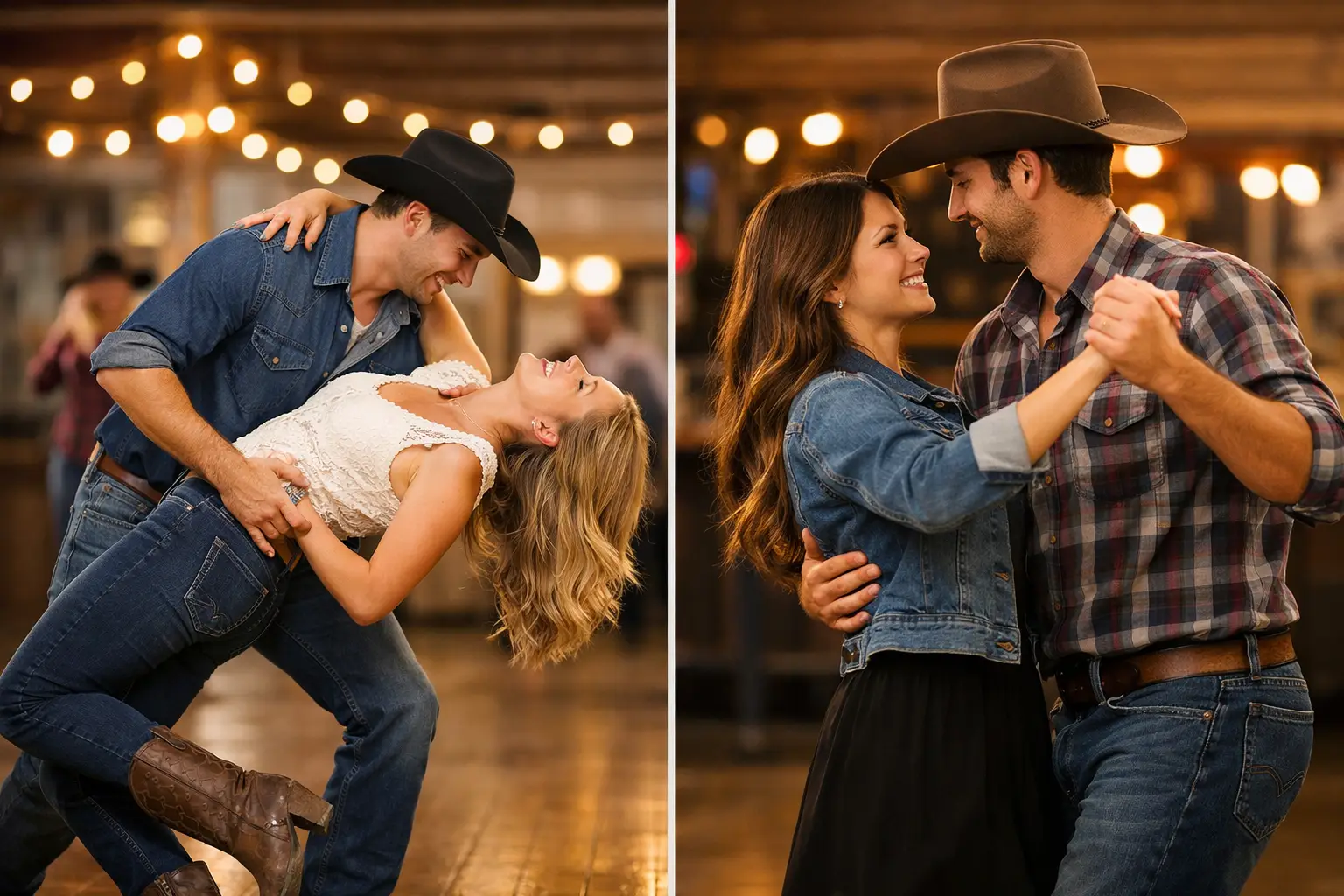
One song comes on and the floor starts turning in neat lanes. The next song hits and suddenly couples are spinning, slotting, and styling all over the room. If you have ever wondered about country swing vs two step, you are not alone. Beginners ask this all the time, and honestly, it is a smart question because these dances may share country roots, but they feel very different once your boots hit the floor.
The easiest way to think about it is this: two step travels, and country swing plays. Two step usually moves counterclockwise around the room with a steady, gliding feel. Country swing tends to stay in one area and uses turns, wraps, pushes, and patterns that feel more relaxed and improvised. Both are social, both are fun, and both can make you feel like you belong on the dance floor fast. But if you learn them as if they are the same dance, your timing and floorcraft can get messy in a hurry.
Country swing vs two step: the big difference
Two step is built to move around the floor. It has a traveling pattern, a clear line of dance, and a rhythm that helps couples progress smoothly with the music. When a room is full of dancers doing two step, it looks organized even when nobody planned it that way. Everyone is sharing the same traffic flow, which is a big part of what makes it work socially.
Country swing works differently. It is usually danced in a smaller space and often in place, or at least without that steady travel around the room. Instead of focusing on covering distance, dancers play with momentum, elasticity, turns, hand changes, and musical accents. It can look flashy, but at its best it still feels comfortable, grounded, and connected.
That difference matters more than people expect. If you try to dance country swing in the middle of a busy two step lane, you become a traffic cone. If you try to force two step patterns into a crowded corner where people are swinging, you will feel boxed in. Same boots, different road map.
How the music feels
Music is where many beginners first notice the split.
Two step usually fits songs with a steady pulse that encourage smooth, continuous movement. Dancers often describe it as progressive and flowing. You are not just hitting counts. You are riding the music around the room. Even when the song has energy, the dance often feels polished and easygoing rather than punchy.
Country swing has more bounce and freedom in how people interpret the song. Depending on the local scene, dancers may use it to mid-tempo country, country pop, or songs with a strong groove that invite turns and playful breaks. The feeling is less about cruising and more about conversation. Lead, follow, react, style, grin, spin, repeat.
There is some overlap, and that is where confusion starts. A song can be country, social, and danceable without being ideal for both styles in the same way. The right answer is often not just about the song itself. It also depends on what the room is doing.
Why rhythm confuses beginners
New dancers often want a simple rule like, “If the song is slow, do this. If it is fast, do that.” Real dance floors are a little sassier than that.
Two step has a more defined underlying rhythm structure, and learning that structure helps everything feel smoother. Country swing is often taught with more flexibility in timing at the beginner level because the focus is on connection, lead and follow, and basic patterns. That can make country swing feel easier at first, especially for people who just want to get out and dance without worrying too much about perfect timing.
But easier at first does not always mean easier long term. Country swing can become complicated quickly once spins, momentum, and styling enter the chat.
What the movement looks like
Two step is about progression. You and your partner move around the floor with purpose, usually using smooth walking actions and turns that keep you traveling. Good two step feels efficient. It is not supposed to look like hard work. The best dancers seem to float, even though they are making constant choices about direction, spacing, and timing.
Country swing is more compact and more pattern-based. You will often see underarm turns, sweetheart positions, pretzel-style hand changes, spins, stops, and little moments that match the music. It has a social, casual energy that many beginners love because it feels less formal right away.
That said, compact does not mean careless. Country swing still needs control. Without clear lead and follow, it can turn into arm wrestling with a soundtrack. Nobody wants that rodeo.
Which one is easier to learn?
It depends on what feels natural to you.
If you like structure, predictable rhythm, and the idea of moving around the room in a clear pattern, two step may click faster. Once you understand the timing and direction, it has a satisfying logic to it. Many adults who are nervous about dancing actually find that reassuring.
If you want something playful and social right away, country swing may feel more approachable in the first few classes. You can learn a basic connection, a few simple patterns, and start having fun quickly. That early success is a big confidence booster.
The trade-off is that two step often rewards consistency, while country swing often rewards adaptability. One is not better than the other. They simply challenge different skills.
Country swing vs two step for real social dancing
This is where practical learning matters. A lot of people are not trying to become performers. They want to go out, hear a song they recognize, and not freeze by the edge of the floor pretending to be very interested in their drink.
Two step is fantastic for larger floors, country bars, community dances, and any event where people are moving in a shared direction. It teaches awareness, partnership, and how to navigate with other couples around you. If your goal is to feel comfortable in classic country dance settings, this style gives you a strong foundation.
Country swing shines when the vibe is more relaxed, social, and playful. It is great for dancers who enjoy variety and like interacting with their partner in a more conversational way. It can also feel more forgiving in casual environments where not everyone on the floor is dancing the same style.
The big social skill in either dance is floorcraft. Good dancers are not just doing patterns. They are reading the room. They know when to travel, when to stay compact, and when to keep things simple. Fancy moves are fun, but not if they send your neighbor into next Tuesday.
Should you learn country swing or two step first?
If your main goal is country socials, bars, and events where traditional country dancing is common, starting with two step often makes sense. It gives you timing, movement, and strong partner awareness. From there, country swing can add personality and variety.
If your main goal is to get comfortable dancing quickly and enjoy something that feels lively from day one, country swing is a great place to begin. It can help nervous beginners relax because the learning curve feels friendly at the start.
For many adults, the best answer is not either-or. It is both, just in the right order for your goals. A good studio will help you learn how each dance works in real social situations, not just in a vacuum. That matters because social dancing is not about memorizing moves in perfect conditions. It is about feeling confident when the music starts and the room is actually moving.
At Dance Class Saskatoon, that practical side is a big part of the fun. The goal is not to make beginners feel behind. It is to get them dancing with confidence, whether they come solo, with a partner, or with two left feet and a good sense of humor.
What beginners usually get wrong
The most common mistake is trying to force one dance into the other. People learn a few country swing turns and then use them during a traveling two step song in a packed lane. Or they try to make country swing too stiff and linear because they are thinking like a two step dancer. That is when things feel awkward.
Another common issue is focusing too much on moves and not enough on connection. In both dances, your partner should feel what is happening, not guess what is coming next. Fancy patterns can wait. Clear lead and follow is what makes social dancing actually social.
It also helps to let go of the idea that one style is more advanced. They are simply different tools. Some nights call for smooth and steady. Some nights call for playful and punchy. The dancers who enjoy themselves most are usually the ones who can recognize the difference and choose accordingly.
If you are deciding where to start, pick the dance that matches the kind of floor you want to enjoy most. Then give yourself permission to learn the other one too. That is not overthinking it. That is building a dance life with more options, more confidence, and a lot more fun when your favorite song comes on.