
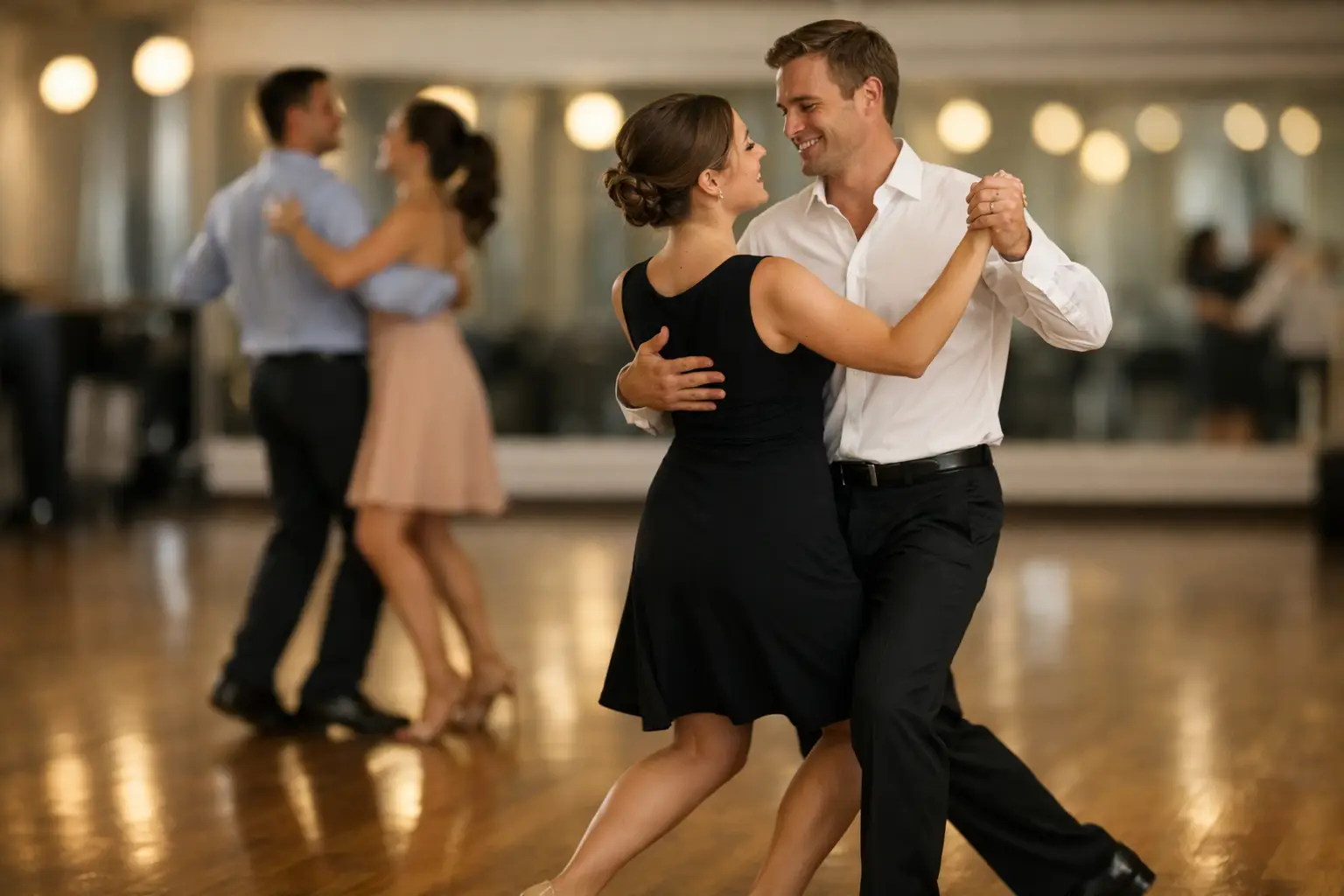
A crowded dance floor is not the place for giant strides, complicated tricks, or a routine that only works in your living room. Foxtrot steps for social floor dancing give you something much better: a smooth, relaxed way to move with a partner while sharing space with everyone around you. The feeling is polished without being stuffy, and once the timing clicks, it is a whole lot of fun.
Foxtrot is a wonderful choice for weddings, community dances, dinner dances, and any evening with easygoing swing-era, big-band, jazz, or pop music. You do not need fancy shoes, a ballroom background, or even a partner to start learning. You need a dependable basic, a little floor awareness, and permission to keep it simple.
What Makes Social Foxtrot Different?
Social foxtrot is built for real people dancing in real rooms. That means your steps stay compact, your lead or follow stays clear, and your attention stays on your partner and the traffic around you. Competitive foxtrot can involve long traveling patterns, dramatic shaping, and precise technical details. Those are beautiful skills, but they are not required to enjoy a song at a social event.
The social version uses a walking rhythm that feels natural: slow, slow, quick, quick. Think of the slows as two counts each, then the quicks as one count each. Count it as 1-2, 3-4, 5, 6. At first, say the rhythm out loud. It may feel a little like patting your head and rubbing your stomach, but your feet will soon recognize the pattern.
The biggest secret is not speed. It is calm movement. A relaxed foxtrot looks smooth because the dancers avoid bouncing, rushing, and taking steps so large that their partner has to hang on for dear life.
Start With the Foxtrot Box Step
The box step gives beginners a clear home base. It is especially useful when the floor is busy because it travels very little. Leaders generally begin with the left foot, while followers mirror with the right foot.
Leader’s box step
Begin in a comfortable closed dance position. Step forward with the left foot on the first slow. Step to the side with the right foot on the second slow. Close the left foot to the right on the first quick, then pause or collect your balance on the second quick.
Next, step back with the right foot on a slow. Step to the side with the left foot on the next slow. Close the right foot to the left on the first quick, then finish the rhythm on the second quick. You have made a small box on the floor.
Follower’s box step
Followers do the opposite: step back right, side left, close right, then forward left, side right, close left. Rather than memorizing a mirror-image list right away, focus on responding to the direction your partner offers. A clear leader makes the movement feel easy. A responsive follower keeps the partnership light and comfortable.
Keep the box small. A step about the length of your own foot is plenty when you are learning. If your steps become wide, the timing gets harder and the partnership can start to pull apart. Small steps are not a beginner compromise. On a full social floor, they are smart dancing.
Move Down the Floor With a Walking Basic
Once the box feels comfortable, add the version that makes foxtrot feel like it is gliding somewhere. The walking basic still uses slow, slow, quick, quick, but the leader travels forward while the follower travels backward.
The leader takes two gentle forward walks, left then right, for the two slows. Then take a small side step left and close the right foot to it for the quicks. The follower mirrors with two backward walks, right then left, followed by side right and close left.
Do not march. Allow your knees to stay soft and let each step roll through the foot naturally. Your upper body should stay level rather than popping up and down with every count. Picture carrying a full cup of coffee across the room. Smooth is the goal, and spilling is optional only if you are at a very lively party.
This pattern works best when the floor has a clear line of dance. At a ballroom or community dance, couples usually travel counterclockwise around the outside edge of the room. Faster moving dancers often stay near the perimeter, while dancers using smaller stationary patterns can stay closer to the center. Following that simple traffic flow makes every dance more comfortable.
Use Turns That Respect Your Neighbors
A quarter turn is one of the most useful additions to the basic. Leaders can angle the forward walking steps slightly to the left, then use the side-and-close to complete a modest turn. Followers will feel the change through the partner connection and follow the new direction.
Start with a quarter turn, not a spin. On a social floor, the goal is to redirect your movement, avoid another couple, or create a pleasant change of view. A small turn is easier to lead, easier to follow, and much less likely to turn into an accidental traffic incident.
If the space is tight, return to the box step. Good social dancers do not force their favorite move no matter what is happening around them. They choose the move the room allows. That is not playing small. That is dancing with consideration, and it makes you a partner people want to dance with again.
Connection Matters More Than Memorizing Patterns
Foxtrot can look effortless, but it is a conversation between two people. In closed position, stand close enough to share direction without leaning on each other. Keep your elbows comfortably lifted, your hands gentle, and your shoulders relaxed. Nobody needs a wrestling grip to dance a basic foxtrot.
Leaders, begin each step with your body moving in the intended direction before your feet go. Your partner can feel that signal more clearly than a tug from the arms. Followers, maintain your own balance and avoid guessing the next move. Waiting a fraction of a second for the lead can feel unfamiliar at first, yet it creates the smoothness that makes partnered dancing so satisfying.
Both partners should keep their eyes up. Watching your feet is tempting, especially during the quick-quick, but it makes collisions more likely and pulls your posture forward. If you lose the timing, simply take two calm walking steps and reconnect to the music. No apology tour required.
Choose Music That Helps the Steps Land
Traditional foxtrot music has a steady, easy-to-hear pulse and enough space to feel the slow, slow, quick, quick rhythm. Big-band tunes are an obvious fit, but many relaxed pop songs work too. The exact tempo matters less than whether you can hear a clear beat and move without rushing.
If a song is very slow, take smaller steps and let the slows breathe. If it is quicker, shorten your stride even more. Trying to cover a lot of ground on a fast song is a fast track to losing balance. When in doubt, keep the quicks tiny and let the music carry the mood.
Practice for Real Social Dancing
Practice does not have to mean repeating a pattern in silence for an hour. Put on one song, dance the box step for a verse, then use the walking basic for the chorus. Change directions with a small quarter turn. Repeat. This gives you a simple, useful toolkit rather than a pile of moves you cannot remember when someone asks you to dance.
Practicing with different partners is valuable too. Every person has a different stride, frame, and sense of timing. Rotating partners in a group class helps leaders refine clear signals and helps followers become comfortable receiving different leads. It also makes the room friendlier, especially for dancers who arrive on their own.
At Dance Class Saskatoon, beginner social dance instruction is designed to take the mystery out of these moments. You can learn the structure, ask questions, laugh at the occasional mixed-up foot, and build confidence before taking your foxtrot to a real dance floor.
The next time a smooth, easy song comes on, do not wait for the perfect opportunity or perfect partner. Offer a hand, start with a small slow step, and let the rest of the floor fade into the rhythm.