
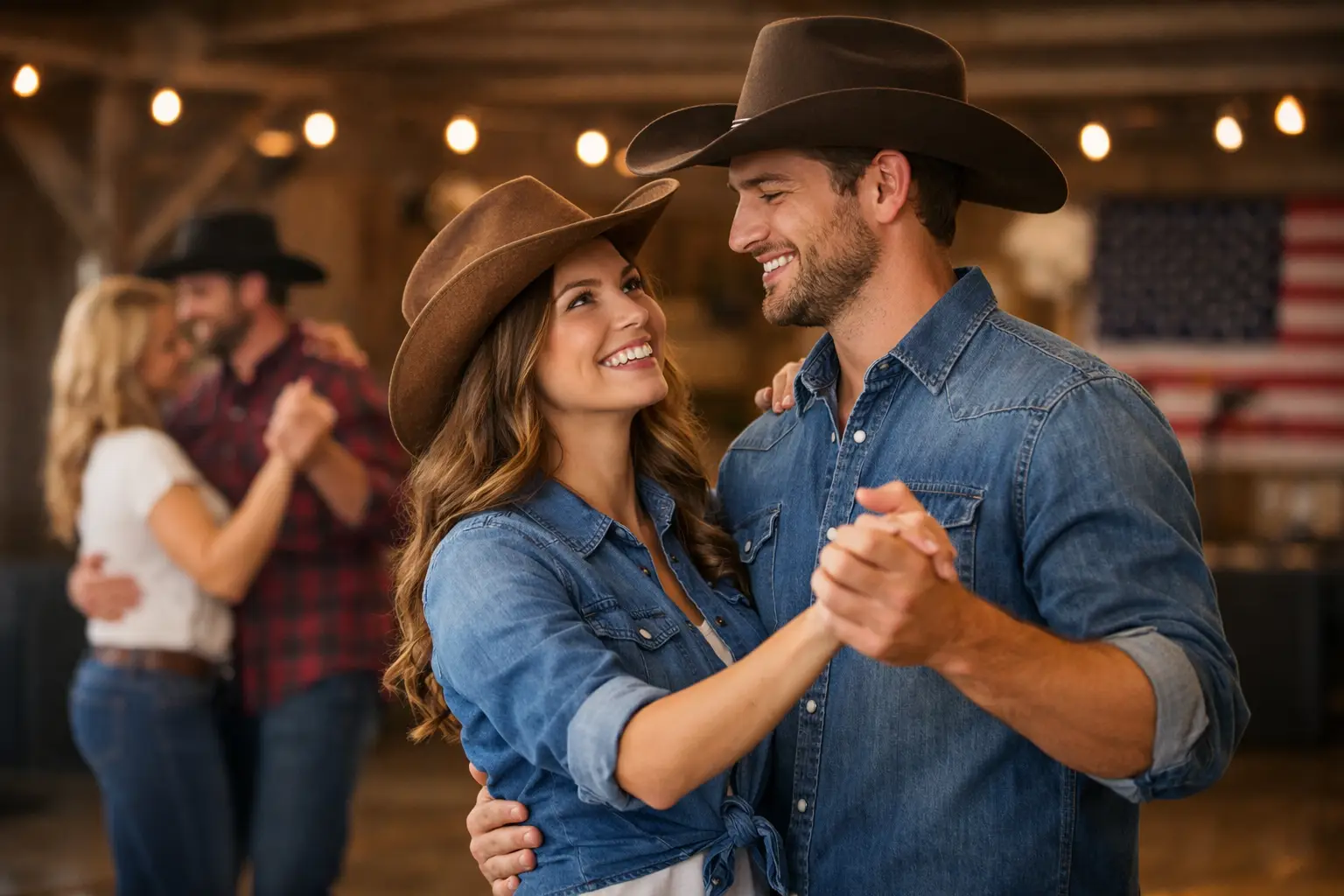
The first few minutes of a country song can feel like a pop quiz: Is this a two-step? A waltz? Do I ask someone to dance or wait? This country partner dance guide takes the mystery out of the dance floor, so you can spend less time standing near the wall and more time having a boot-scootin’ good time.
Country partner dancing is social dancing at its friendliest. You do not need sparkly boots, a cowboy hat, or a partner who has danced for years. You need a few dependable steps, a sense of the music, and the willingness to laugh when a turn goes slightly sideways. That is how real social dancers learn.
What counts as country partner dancing?
Country partner dance is not one single dance. It is a family of social dances commonly heard at country bars, community halls, weddings, and dance events. The song, its tempo, and the local crowd usually determine what people dance.
The big three for beginners are country two-step, country waltz, and country swing. Two-step is smooth and traveling, with a quick-quick-slow rhythm that moves around the room. Waltz is graceful and circular, counted in groups of three. Country swing is bouncy, playful, and often danced in a smaller space with turns and a little more personality.
You may also see cha-cha, polka, nightclub two-step, or line dancing on a country night. That variety is part of the fun, but it can also be why new dancers feel unsure. Start with one or two dances rather than trying to learn every pattern at once. A comfortable basic step will take you farther than a dozen half-remembered moves.
Country partner dance guide: Start with the music
Before your feet do anything fancy, listen for the beat. Most country partner dances are built on a repeating musical pattern. Your job is not to count every instrument. Simply find the steady pulse that makes you want to tap your foot.
For country two-step, listen for a quicker, driving beat. The basic rhythm is often taught as quick, quick, slow, slow. Your steps should feel like you are moving forward through the song, not marching in place. If the music is very fast, make your steps smaller. Big steps might look dramatic in a lesson, but they make a crowded social floor harder to navigate.
For waltz, feel the gentle rise and fall of one-two-three, one-two-three. The first count usually feels more grounded, while the next two counts flow along. If you have ever swayed to a slow country love song, you already understand the mood. Waltz is less about rushing and more about moving together.
Country swing has a more relaxed pulse. Depending on the song and the local style, dancers may use a basic rock step, triple steps, or a simple side-to-side rhythm. Do not worry if two people at the same event dance it a little differently. Social dance has room for regional flavor. Connection and timing matter more than performing an exact version.
Leading and following without the pressure
A good lead is not forceful, and a good follow is not passive. Both partners are paying attention, sharing balance, and responding to the music. Think of it as a conversation, not a steering contest.
If you are leading, begin with a clear frame. Keep your arms comfortably engaged, your shoulders relaxed, and your hands at a natural height. Use your body to suggest direction before your arms try to move your partner. A turn should feel like an invitation with enough time to respond, not a surprise quiz halfway through the count.
If you are following, keep your own posture and balance. Avoid guessing a move before it is led, even if you recognize it. Waiting a fraction of a beat gives your partner useful feedback and makes the dance feel lighter. If a lead is unclear, continue the basic step. That is not a mistake. It is smart social dancing.
Everyone benefits from learning both roles. Leads gain a better understanding of what information a partner needs. Follows learn how a movement is put together and become more adaptable with different partners. At Dance Class Saskatoon, rotating partners in class is one practical way to build those skills, but you are always welcome to dance with the same person when that suits your comfort level.
The social dance floor has its own rules
Country dancing feels relaxed, but a few habits make the floor safer and more enjoyable for everyone. The most important rule is simple: match your dancing to the space around you.
Traveling dances such as two-step and waltz generally move counterclockwise around the outside of the floor. Faster dancers usually stay toward the outer edge, while slower dancers travel a little farther in. Swing, stationary patterns, and smaller turns belong closer to the center. This is not about being strict. It prevents collisions and keeps the floor flowing like a good song.
Keep turns compact when the room is busy. Save big traveling moves, dips, drops, and aerial-style tricks for open spaces and only when both partners are trained and comfortable. On a packed floor, a simple turn done well looks better than a flashy move that sends someone scrambling.
When asking someone to dance, a friendly “Would you like to dance?” is all you need. Accept no gracefully, and do not take it personally. People may be resting, waiting for a friend, or simply sitting out that song. If you do dance together, a quick “Thank you” afterward goes a long way. Good floor manners make you the kind of partner people are happy to dance with again.
Build a small set of moves you can trust
New dancers often believe they need more moves to look confident. Usually, the opposite is true. Confidence comes from repeating a few foundations until they feel easy enough to enjoy the song and your partner.
For two-step, start with the basic, a gentle change of direction, and an underarm turn. For waltz, learn the box-style feeling, a turning pattern, and how to travel smoothly down the line of dance. For country swing, focus on a solid basic, a send-out, and a simple turn. These are not “beginner moves” in a bad way. Experienced dancers use them all night because they work with many songs and many partners.
Once your basic is steady, add one new pattern at a time. Practice it slowly before trying it at full social-dance speed. If it falls apart, return to the basic without apologizing for the next five minutes. Recovering calmly is a real skill, and it makes dancing feel much more fun.
What to wear and bring to a country dance class
Wear clothes that let you move comfortably. Jeans, casual pants, skirts that allow easy steps, and a breathable top are all fine. You do not need special dancewear for your first class.
Shoes matter more than most people expect. Choose something secure on your foot with a sole that can slide a little without being slippery. Athletic shoes can work at first, though very grippy soles may make turns harder on some floors. Cowboy boots are welcome if they are comfortable, but they are definitely not required. Start with what you have, then decide later whether dance shoes are worth it for you.
Bring water, arrive a few minutes early, and leave room in your expectations for learning. You may feel coordinated one song and wonderfully uncoordinated the next. That is normal. Country partner dancing asks your brain to hear music, move your feet, connect with another person, and navigate the room at the same time. Give yourself credit for showing up.
The fastest way to get comfortable
Classes give you the building blocks, while practice turns those blocks into a dance. A multi-week series is especially helpful because each lesson builds on the previous one. You get time to settle into the rhythm, ask questions, and dance with people at different experience levels.
Practice parties and social events are where the magic starts to click. You will notice that most people are not judging your footwork. They are focused on their own steps, enjoying the music, and hoping someone asks them to dance. Choose one song each time you attend, use the basic you know, and call it a win.
The goal is not to become perfect before you join the floor. The goal is to become part of the floor. Start with a simple step, offer a smile, and let the next country song give you somewhere to go.